


There is a saying we often repeat in Haiti to describe human nature:
“Ou te mèt fè yon moun 1000 byen, jou w fè l yon mal se li lap toujou sonje”
No matter how many good things we do for someone, it is easier for them to remember the one wrong we did to them.
This is even more true for the mind of a child than for that of an adult.
That is why parents must always be careful and pay attention to the way they interact with their children. Even if you treat your child well every single day, the moment that attitude changes—even just once—it can change the way they remember you for the rest of their childhood.
Imagine that you always help your child with their homework. You are patient and explain everything clearly. Despite the difficulties, you are always there. Learning with you is enjoyable, and the child feels safe.
But one day, after a difficult day, something deeply upsets you. Lost in an emotional fog, you lose control and tell them they are stupid and too slow to learn...
That moment can create a wound the child may carry for the rest of their life, profoundly affecting the way they judge themselves, their sense of worth, and their abilities.
All of this is simply to say that the mind of a child is fragile and requires constant care. Many of our wounds come from a break in that care.
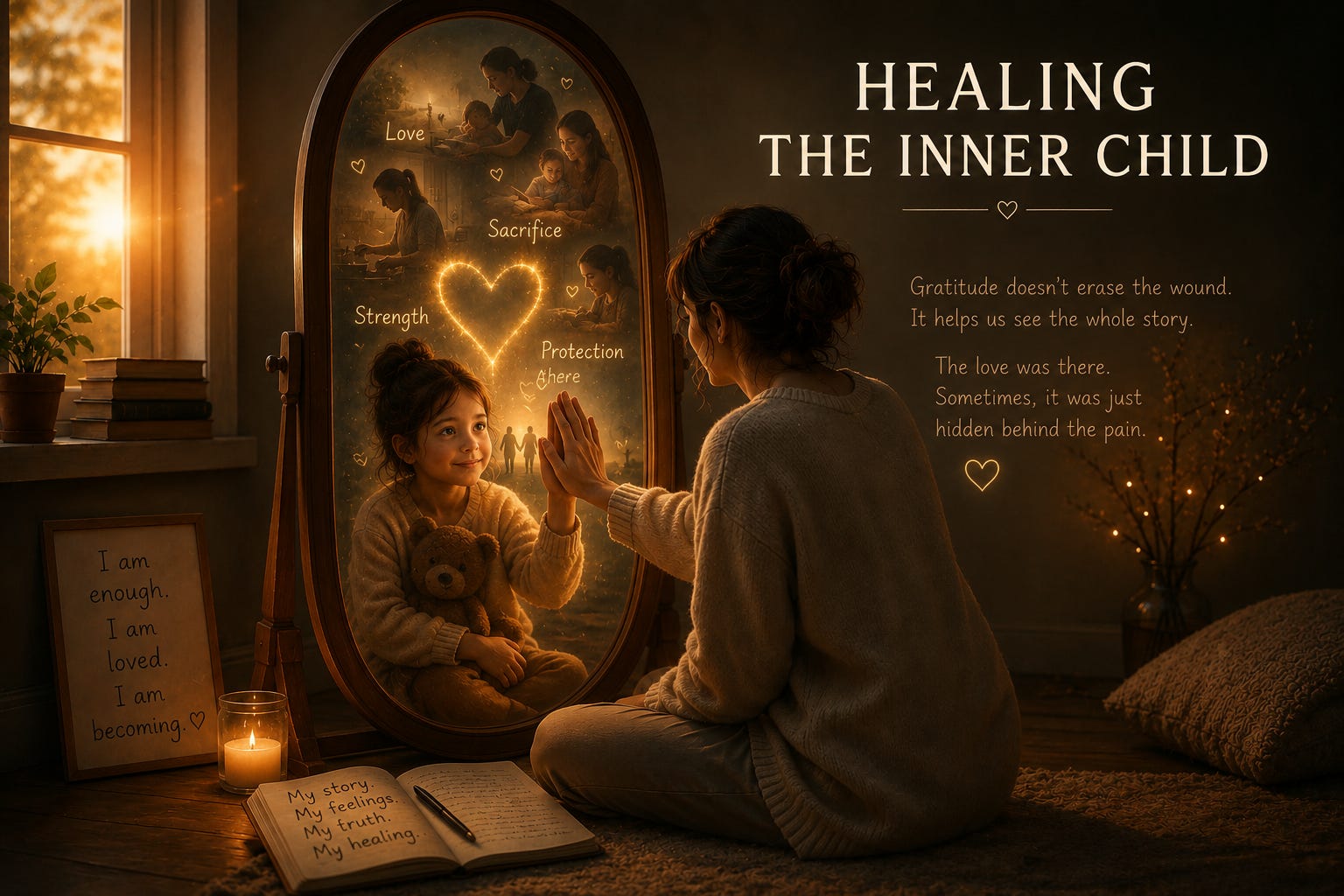
That is why I believe it is important to revisit the events of our childhood through the eyes of the adult we have become. It is like walking beside the child and helping them see what they could not understand at the time.
I am not going to discuss whether all of this could have been avoided. At this point, it is no longer important. For me, it no longer was. It is too late to prevent the wound. What has been done cannot be undone.
But when we are wounded, we can clean the wound and allow it to heal. The scar may remain, not as a punishment, but as a lesson.
We can simply accept what happened and try to look deeper, and begin asking a different question:
What lies beyond the wound?
From there, we can recover certain things that our child’s mind set aside:
The qualities
the love
the affection
the sacrifices of the people who raised us.
My mother is a strong woman who loves and protects her family. Even if it meant drowning in debt, she never let us go hungry or without clothes. She was present in managing our home, always supporting my father.
There was a dynamic in our home that I loved, despite the problems they had: they shared responsibilities.
My father was mainly responsible for providing financially, but my mother contributed as well. We always knew exactly which parent to turn to depending on the need. And when one of them could not meet it, the other covered the expense without hesitation.
They never had any problems in that regard.
Looking back at those events with an adult’s perspective, I was able to see a woman who had a difficult childhood and who still carries wounds she may not even understand today... A woman who was never taught how to properly raise children, yet did everything she could to offer her children a better future.
Her flaws are impossible to ignore:
Her loss of control.
The vulgar words and expressions.
Her bursts of anger.
Seeing those things helped me understand some of my own fears more clearly. I discovered that I did not want to be like my mother, not completely.
At one point, I carried a great deal of anger within me, and my own outbursts became so frequent that I stopped drinking coffee, believing it was the cause.
After spending time with the child deep within me and looking at his wounds, I was able to understand where that anger came from. Coffee was never the cause; it was only a deflection. I was not afraid of becoming completely like my mother. I was afraid of repeating those destructive patterns.
Understanding that allowed me to see her love, and just what an amazing woman she is.
She is extraordinary. And when I think about some of the qualities I hope to find in a woman, that vision comes from her. And many of the things I refuse to tolerate in a woman also come from her.
The intention has never been to idealize her, but to see her as she truly is—with her strengths as well as her flaws. To acknowledge her good actions just as much as her mistakes, and to see the mechanisms behind them.
Little by little, I was able to let go of my resentment. It was not easy. It did not happen quickly. I had to take the time to help my inner child understand so that we could move forward.
Then that resentment was replaced by something healthier: gratitude.
I believe that despite the wrongs a parent may have done to us, if we look deeply enough within ourselves, we can always find something to be grateful for. Even if it is simply the fact that they served as the instrument through which our life came into being.
That does not mean we owe them something because of it. Being able to understand them does not necessarily mean forgiving them or forgetting what they did to us in the past.
But I believe that replacing anger with forgiveness and gratitude has proven more beneficial for the person I am and for the person I can still become.
In doing so, our lives may become a little lighter.
Thank you for taking the time to read these reflections and for allowing me to share this part of my journey with you.
🪞 Mirror question to reflect on:
After looking beyond the wound, what are you grateful for today?
CTA
“The greatest discovery in life is self-discovery. Until you find yourself, you will always be someone else. Become yourself.”
— Myles Munroe
If this reflection spoke to you, if it resonated with something within you, consider becoming a paid subscriber.
The Clarity Practice invites you into a more personal exploration of your own story. Through guided questions and reflection exercises, it offers an opportunity to better understand the wounds, beliefs, and adaptations that may have emerged in childhood, recognize the stories you have carried for years, and begin looking at them through the eyes of the adult you have become.
Because the longer an unexamined conclusion remains in place, the more opportunities it has to shape our relationships, our decisions, and our sense of self.
Continue the exploration and access this week’s Clarity Practice.
If becoming a paid subscriber isn’t possible right now, that’s perfectly okay.
This space has always been built slowly—with time, stillness, and presence.
If this work has helped you better understand yourself, your relationships, or the world around you, and you would still like to support its continuation, you can always leave a tip.
Your presence here already means a great deal.
Thank you for being part of The Mirror Room.
With clarity,
The Mirror Room
Odel A.
This really speaks to so much of the inner healing work I’ve done myself, inner child work, gratitude, forgiveness, and learning to look back with adult eyes at what the child in us couldn’t possibly understand at the time. I recently wrote about something from my own childhood involving my little sister, where I completely misunderstood what I had witnessed and carried a belief that was never true. As a child, I didn’t know what to do with that pain, and some of it came out toward her. It took us years of healing, but today she is one of my best friends. So your reflection on looking beyond the wound really landed for me. Not to erase what hurt, but to understand it differently, soften around it, and choose what is worth keeping. Beautiful reflection. ❤️
This was a touching reflection and you captured the understanding and damage that can happen to the child very well.