


There is a saying:
“History repeats itself.”
We usually hear it when talking about events that happen again, such as major economic crises. Within a family, it can describe people who repeat the behaviors of their parents or previous generations, or who end up living through similar circumstances.
On a more personal level, we often use it to describe people who keep making the same mistakes. Someone who repeatedly finds themselves in toxic relationships, for example. With every new partner, the same patterns seem to emerge.
While reflecting on the healing of the inner child and revisiting my past through adult eyes, I found myself repeating that saying in an even more personal context: identity.
I believe most of us don’t simply want to heal. We also want to understand why we became the person we are today.
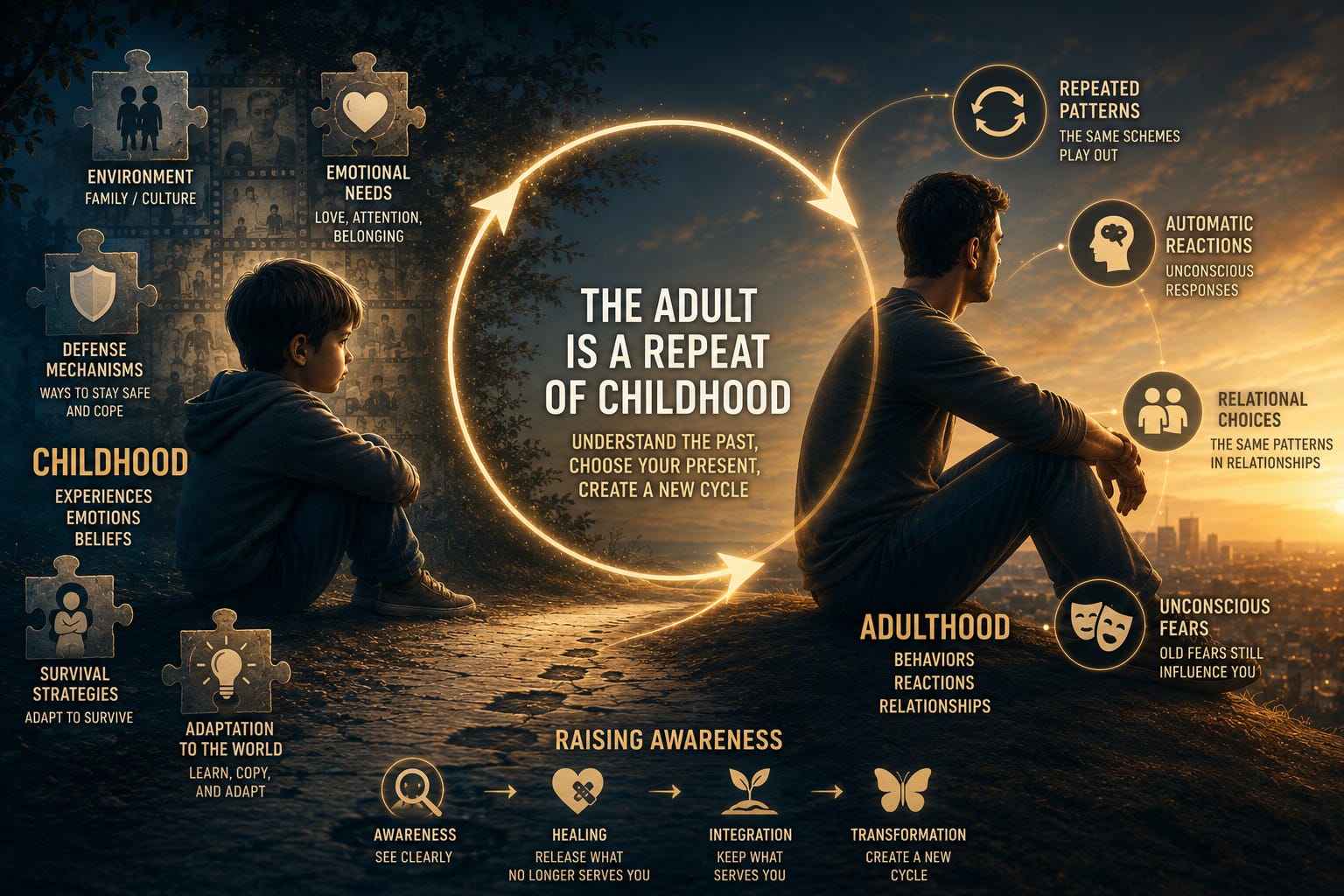
Many aspects of our adult behavior have their roots in childhood. Some of our reactions, attitudes, and habits are simply repetitions of strategies the child within us once created.
Our childhood as a whole—its joyful moments as well as its wounds—forms the foundation of our identity. We began defining who we were long before we even understood what identity meant. We learned by copying others and adapting to different situations. In many ways, we first came to define ourselves through other people.
We learned their language, their way of thinking, their values, their culture, and their way of living. These became our foundation. Then, as we grew, we had to adapt to our environment in order to live—or sometimes simply to survive.
The child within us, highly sensitive to emotions, developed different strategies to get what they needed, protect what felt precious, or simply avoid trouble. They created strategies:
to preserve a relationship,
to stay safe,
to avoid rejection,
to avoid shame,
to remain loved,
to avoid becoming what they witnessed…
As those strategies were repeated over and over again, they gradually became behaviors we still carry today, even though we often forget where they came from.
I have always been someone who smiles.
Even when someone insults me, my first instinct is usually to smile and decide later how I want to respond. For a long time, I hated that about myself. I didn’t feel like a “real man.” I believed that if someone insulted me, I should immediately answer back.
But I never did.
I would absorb the insult, smile, and quietly distance myself from that person.
I rarely get angry, and when I do, it always surprises the people around me. Most of them genuinely believe that I never get angry.
I had never really questioned this until I began writing these reflections. Only then did I start wondering where this habit came from.
I think it is an echo of my childhood.
I grew up in a home filled with conflict. My parents argued constantly. It brought me an incredible amount of shame, and deep inside, I didn’t want to become like that.
Even as a child, when someone insulted me, instead of insulting them back, I would smile, keep my anger to myself, and distance myself afterward. When I lose control of my anger, I know I can become vulgar and hurt people with my words. Somehow, the child in me found a way to avoid repeating the same patterns I saw in my parents.
I don’t even remember when it started, but smiling became part of my identity.
Today, however, things are different.
The child kept everything inside because he didn’t yet have the tools to express his emotions or set healthy boundaries. Today, I’m no longer obligated to accept insults with a smile. I’ve learned healthier ways to express myself and respond when necessary.
But the smile has remained.
And I actually like that part of myself.
This realization brings me back to the idea that childhood is the foundation of who we are. When adults take the time to revisit that childhood, they may discover a different perspective—a different way of seeing themselves.
Perhaps with greater clarity.
Greater peace.
Greater serenity.
Perhaps the child built an identity simply to survive.
Now the adult has the opportunity to discover which parts of that identity still truly belong to them... and which parts they are finally free to leave behind.
People often say that understanding a problem is already half the solution.
I don’t consider childhood to be a problem—not as a whole. But being able to revisit our earliest values and experiences with clarity gives us a much stronger sense of direction moving forward.
To me, it’s like receiving a surge of strength. Or perhaps even more accurately, like gradually finding where each piece belongs in an enormous puzzle that is someone’s life.
It is a return to the authentic self.
Perhaps healing the inner child isn’t only about revisiting our wounds and tending to them. Perhaps it is also about recognizing and understanding the old strategies that slowly became part of our everyday behavior.
That kind of clarity can give us greater objectivity... and greater freedom in the choices we make.
🪞 Mirror Question:
Which parts of your identity still feel like you... and which parts may simply be strategies the child within you created to survive?
This Week’s Poem

Previous Post :
Healing The Inner Child (part 5): The Parent I Never Questioned

I have always held my father in high regard. He is someone I love deeply. Despite the fear I sometimes felt toward him, I always felt close to him and safe with him.
Healing the Inner Child (part 4) : The Child Saw Only Half the Story

Sometimes, the greatest danger after a wound does not come from the wound itself, but from the infection that follows. A simple cut, one that could have healed easily, can become far more serious—even life-threatening—because of an infection.
CTA
“The greatest discovery in life is self-discovery. Until you find yourself, you will always be someone else. Become yourself.”
— Myles Munroe
If this reflection resonated with you, consider taking the next step.
The Clarity Practice is where reflection becomes personal exploration. Through guided questions, writing exercises, and practical frameworks, it helps you uncover the childhood conclusions that may still be shaping your relationships, decisions, and identity—so you can begin making more conscious choices instead of repeating unconscious patterns.
The longer a pattern remains unseen, the more opportunities it has to shape your life.
Unlock this week’s Clarity Practice by becoming a paid subscriber.
If becoming a paid subscriber isn’t possible right now, that’s completely okay.
Every reflection, poem, and practice shared in The Mirror Room takes time, thought, and care to create. If this work has helped you better understand yourself, your relationships, or the life you are living, you can also support its continuation by leaving a tip.
Your support doesn’t simply fund another post.
It gives this work the time and freedom to keep growing—and encourages me to continue creating resources that help more people see themselves more clearly.
Thank you for being part of The Mirror Room.
With clarity,
Odel A.
The Mirror Room
I’m glad you kept the smile, Odel-chan~ You don’t need it to protect yourself the same way anymore. You just like that part of yourself now, and I’m happy for you.
Perhaps the child built an identity simply to survive. Now the adult has the opportunity to discover which parts of that identity still truly belong to them.' That line is going to sit with me for a long time. Thank you for writing such a wise and compassionate essay!