


This journey of healing the inner child has led me to what I believe is the very core of every person’s existence: identity.
We had to define who we were before we even understood what it meant to be someone. We adapted to the stories told around us, the principles passed down to us, the beliefs of a community, and above all, the behaviors of the people around us.
During childhood, we were unaware of the importance of the choices we were making. What may have started as a way to attract attention or a way to assert ourselves gradually became a repeated behavior, and eventually, a part of our identity.
Children are very emotionally intelligent. They notice changes in the attitudes of the people around them. They absorb the emotions surrounding them, and they adapt.
A child can sense when a parent is sad, happy, in a good mood, or in a bad one. They possess that emotional intelligence. What we lack at that stage is the ability to mentalize—that is, the ability to understand that other people’s behaviors, emotions, and reactions are influenced by their own mental states (thoughts, intentions, emotions, and needs), and not necessarily by us.
From a child’s perspective, things are either black or white; either for us or against us. We rarely see another person’s perspective, which is perfectly normal. Perhaps a child is not meant to understand someone else’s perspective because they don’t yet understand what it even means to have one. Instead, they develop their own based on what they absorb from the world around them.
Looking back at our childhood through adult eyes allows us to become aware of the behaviors we had to develop, our identity, our strengths, as well as our flaws.
As children, we do NOT consciously choose our identity.
A child does not say to themselves:
I am going to become someone who avoids conflict.
I am going to become someone who overexplains.
I am going to become someone who stays silent to please others.
I am going to become someone who always expects failure or who sabotages themselves.
These are not conscious decisions. And yet, one day, we realize that we have become that person. More often than not, it is the result of what we received during childhood and how we learned to respond to it at the time.
Recently, someone at work made a remark that made me think deeply. I was quietly walking, lost in my thoughts, when I noticed one of my coworkers acting a little suspiciously. It wasn’t anything serious. It was as if she expected me to do something to tease her.
I stopped and asked,
“Why are you acting as if I’m about to do something to you?”
“Because you ALWAYS do something to annoy me,” she replied.
“Really? I do that all the time?” I asked, genuinely surprised.
She confirmed it with a smile.
Then I went back to focusing on my work.
Nevertheless, the thought stayed with me. I quickly realized she was right. I tease people. Not in a mean-spirited way—just enough to lighten the atmosphere. And if I notice someone doesn’t enjoy it, I stop. Most of the time, I do it to break the ice or perhaps to attract a little attention.
I began wondering where that behavior came from, and I thought about it for a long time. Then, while writing these reflections on healing the inner child, I began to see where it had started.
I grew up with my older brother. He was three years older than I was, and through one of those strange twists of providence, we ended up in the same class in third grade. From then on, we were almost always together. The same classroom. The same friends. We even looked alike physically—almost the same height—that people often mistook us for twins.
My brother was serious, responsible, and hardworking. He was usually among the students sitting in the front rows, paying close attention to everything. I, on the other hand, adopted the exact opposite behavior. Perhaps it was my way of distinguishing myself from him because I had grown tired of constantly being compared to him. I wanted to be seen for who I was.
So I became the little rebel, the teaser. I was usually found in the back rows among the students paying the least attention and spending their time bothering everyone else. I lived that way for more than a decade. Whenever my brother adopted one behavior, I often adopted the opposite.
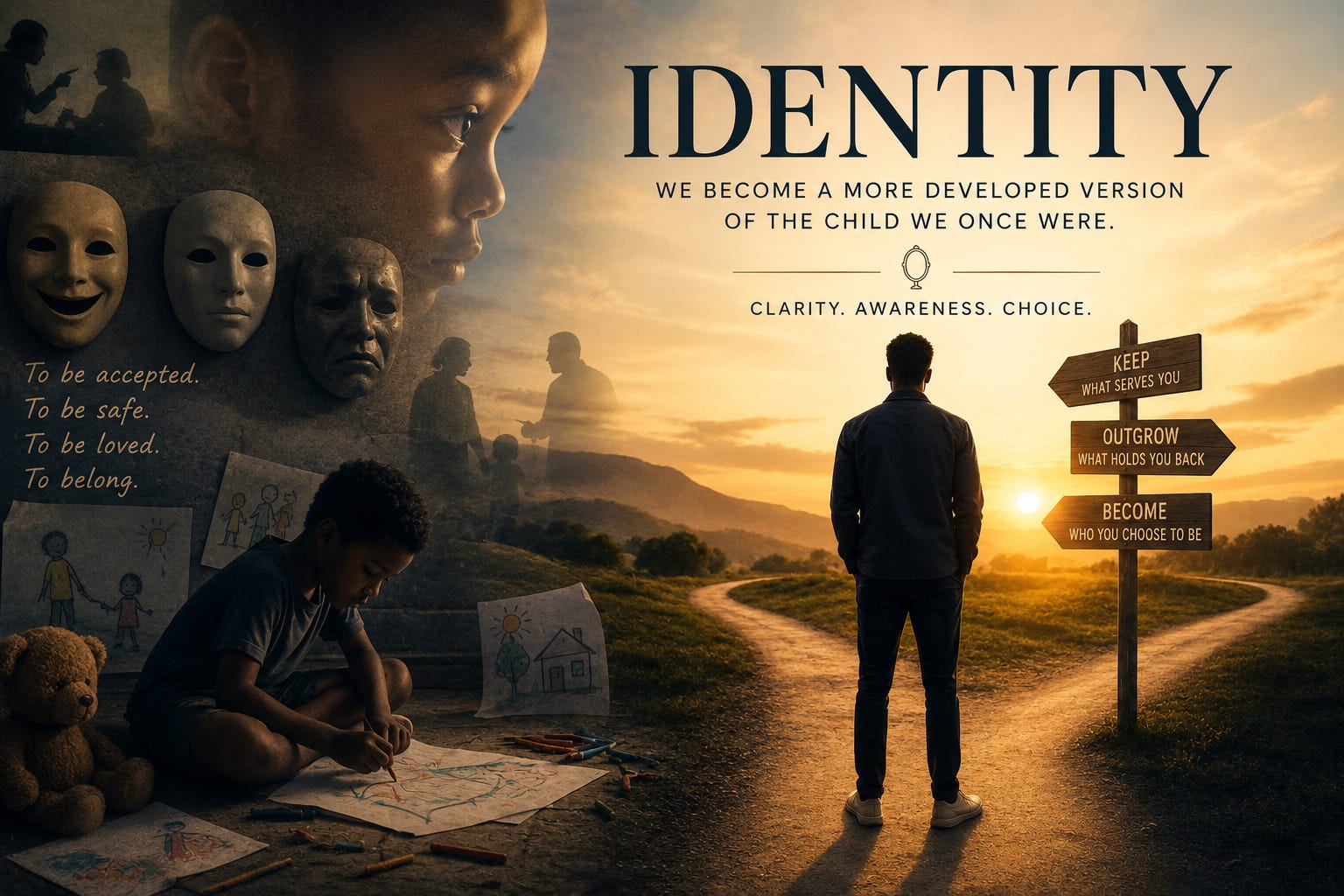
I accumulated behaviors over the years that are still part of who I am today, even as an adult. It made me realize that becoming an adult does not mean becoming a completely new person, but simply becoming a more developed version of the child we once were. In other words, we become more responsible, develop a stronger sense of duty, and gain greater awareness of who we are and what we do.
Think of it like an updated version of a product. Take an iPhone, for example. The iPhone 17 is nothing more than an improved version of the original model. The underlying technology remains the same, but the latest version is more sophisticated, with new features developed over time.
I like my playful side. It helps me interact with people and integrate into society more naturally.
Recently, I called an Uber to go home after work. The driver happened to be a fellow Haitian. I started talking to him in our native language, and he asked me:
“Ou pale kreyòl?” (”You speak Creole?”)
“Ayiti m grandi pandan 19 ane.” (”I was raised in Haiti for 19 years”), I told him.
Then he asked me,
“Kisa w ap fè la?” (”What are you doing in the U.S.?”)
Me: “Hm ?”
“Kòman w fè twouve w la?” (”How did you end up in this country?”) it repeated.
There was no aggression in his voice, and he didn’t seem to be judging me. I quickly realized he was teasing me a little. So I answered in a serious tone.
“Monchè, dòmi m dòmi epi lè m reveye m wè m la.” (”My friend, I simply went to sleep, and when I woke up, I found myself here.”)
We laughed and had a wonderful conversation for the rest of the ride.
All of this is simply to say that not every part of our identity inherited from childhood needs to be rejected.
The child within us does not disappear, but we accumulate knowledge, experience, and wisdom.
The adult does not completely replace the child. They retain much of the child’s original architecture, but with greater experience, greater awareness, language, responsibility, and a wider range of possibilities for action.
Perhaps identity is not about becoming someone else, but about understanding who the child within us became, why, and deciding what we choose to carry into adulthood—and how.
🪞 Mirror Question:
Which part of your childhood identity still feels authentically yours... and which part do you think you’ve simply outgrown?
If this text brings you clarity, understanding and self-awareness, please consider becoming a paid subscriber to support this place.
With clarity,
Odel A
The Mirror Room
I love the progression you make here, we’re all iPhones!
I love this ♥️