


Most people spend years searching for love. Far fewer ask what happens after they find it.
Love is something beautiful, something magnificent—a powerful force available to each of us. It is neither fair nor unfair. It is an energy.
Take electricity, for example. We can use electrical power for many different purposes. Each person uses it to power their own devices.
One remarkable thing about electricity is that we are always concerned with how much of it we need, or how much we can afford.
Love does not harm. Neither does it heal by itself. What it becomes depends on the responsibility of the person who carries it. It is possible to love someone and still hurt them, even when our intention is often to do good.
Throughout these reflections, I have come to believe that the path toward finding and living a fulfilling love begins with knowing yourself. Before loving someone else, you must first learn to know yourself. Know your limits, your strengths, and your weaknesses as well.
For love, when shared, should be an extension of the love you have for yourself. By that, I mean that if I choose to be in a relationship with a woman, she should be someone who accepts me as I am. Someone with whom I can feel free and comfortable in my own skin, with possibilities to grow. And vice versa.
I have often compared romantic relationships to business. I know this may sound too materialistic to some people, but the logic is simple: a romantic relationship, like a good partnership, should be an exchange made in good faith that benefits both people involved.
Just as I hope to be understood, accepted for who I am, and supported by the other person, I must also be capable of treating her with kindness and becoming a true refuge for her.
It is not:
you rejoice while he or she suffers.
Rather:
we rejoice together, and in times of suffering, we support one another as well.
A romantic relationship is not a competition. It is not every person for themselves. I believe, and will continue to defend, the idea that each individual continues to exist as their own person within a relationship. But let us not forget that they are now also part of something larger. And harmony within that shared space should remain one of the highest priorities.
These reflections are not absolute truths, nor formulas for success. They are simply reflections drawn from my own experiences and observations.
And as Socrates once said:
“If there is one thing I know, it is that I know nothing.”
Indeed, I know nothing about love. I am like you—someone who has lived, who has loved, and who is searching for a way to build a peaceful love and something lasting through understanding, tolerance, flexibility, and responsibility.
Some of these reflections may have resonated deeply with you, while others may have stood in complete opposition to what you have experienced or believed about love. And that is perfectly legitimate.
For the only truth is that no one can define love for you. Not me, not your friends, not your parents, and not the experts.
Only you can decide what love is and what you want it to be in your life.
The rest of us can only offer observations, advice, and perspectives—guides and mirrors that may help you find your own path.
That being said, I hope these reflections serve as mirrors that allow you to reflect, understand, and discover the essence of your own way of loving.
Let me leave you with one final reminder:
Love is never fully secured.
Tell yourself that you must win the heart of the person who shares your life, every single day.
Think of love like a plant. If it is not watered, if it is not cared for consistently, it will eventually wither away, replaced by indifference, coldness, or even resentment.
Before closing this journey, I would like to thank you.
Whether you have read a single reflection or followed all eighteen of them, I am grateful that you chose to spend a portion of your time in this space. Time is one of the few things we can never recover once it is given, and I do not take that gift lightly.
Although each reflection was written to stand on its own, they were also conceived as parts of a larger picture. Each one explores a different angle of love, and together they form a broader attempt to understand one of the most powerful and mysterious forces in human life.
For that reason, I encourage you to read them as a whole whenever possible. Not because they provide definitive answers, but because each reflection builds upon questions raised by the others. What may seem incomplete in one text often finds another perspective in the next.
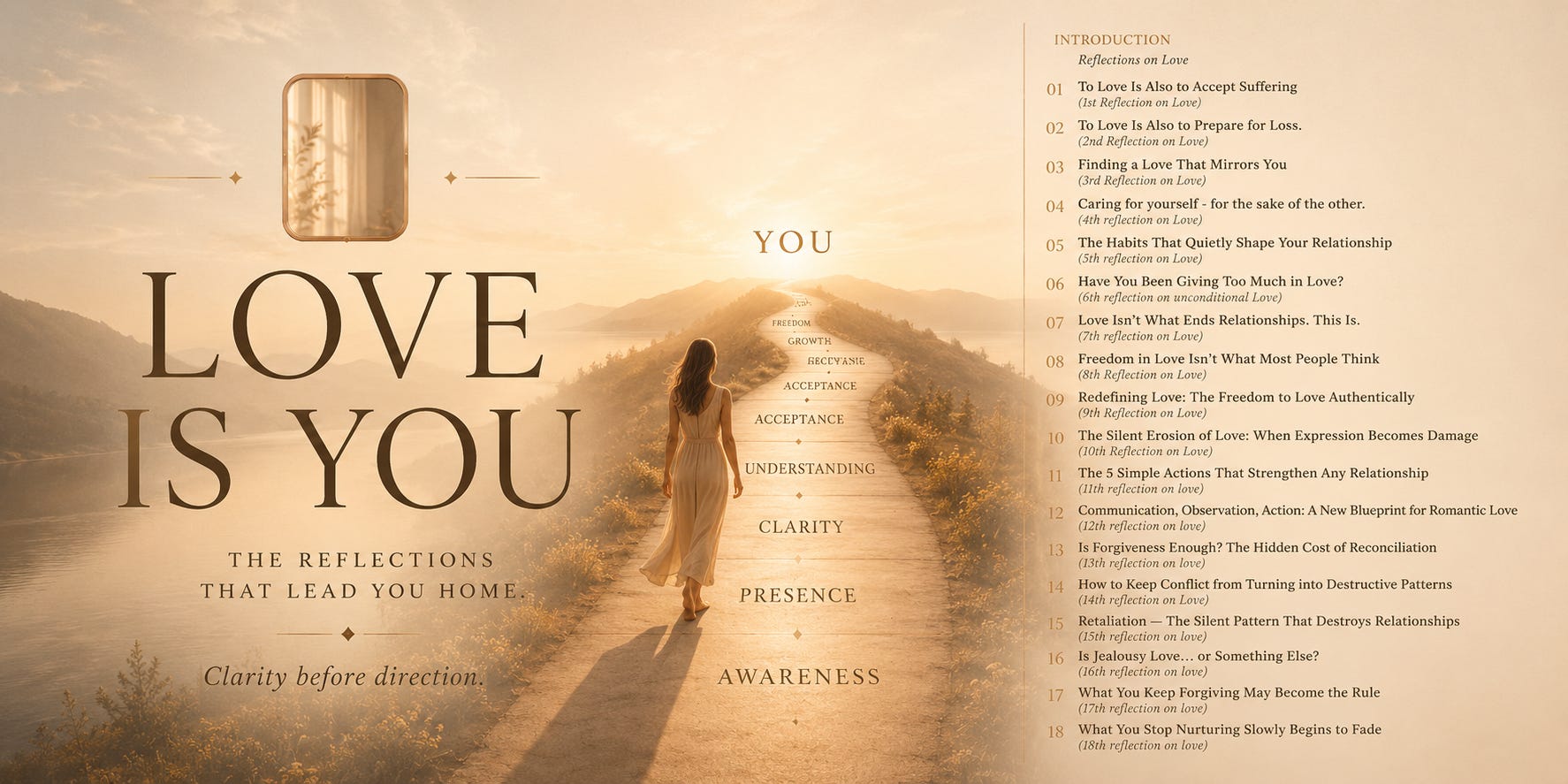
If you would like to follow the journey from beginning to end, the roadmap below offers a guide through the eighteen reflections that make up this series.
1st Reflection on Love — To Love Is Also to Accept Suffering
2nd Reflection on Love: To Love Is Also to Prepare for Loss.
4th reflection on Love: Caring for yourself - for the sake of the other.
The Habits That Quietly Shape Your Relationship (5th reflection on Love)
Have You Been Giving Too Much in Love? (6th reflection on unconditional Love)
Love Isn’t What Ends Relationships. This Is. (7th reflection on Love)
Freedom in Love Isn’t What Most People Think (8th Reflection on Love)
Redefining Love: The Freedom to Love Authentically (9th Reflection on Love)
The Silent Erosion of Love: When Expression Becomes Damage (10th Reflection on Love)
The 5 Simple Actions That Strengthen Any Relationship (11th reflection on love)
Communication, Observation, Action: A New Blueprint for Romantic Love (12th reflection on love)
Is Forgiveness Enough? The Hidden Cost of Reconciliation (13th reflection on love)
How to Keep Conflict from Turning into Destructive Patterns (14th reflection on Love)
Retaliation — The Silent Pattern That Destroys Relationships (15th reflection on love)
Is Jealousy Love… or Something Else? (16th reflection on love)
What You Keep Forgiving May Become the Rule (17th reflection on love)
What You Stop Nurturing Slowly Begins to Fade (18th reflection on love)
Thank you for walking this road with me.
🪞 Mirror Question:
Of all eighteen reflections, which one stayed with you the most?
And if there is a lesson, observation, or reflection on love that you believe should have been included in this series, what would it be?
If these reflections have brought you something meaningful, feel free to leave a like, share your thoughts, or pass them along to someone who may need them.
Free subscribers receive each new reflection and every poem added to the Vault — invitations to pause, observe, and see a little more clearly.
For those who wish to go further, The Evening Mirror offers deeper structural explorations, practical tools, reflection practices, and the Monthly Guide to Clarity — designed to move beyond recognition and toward deeper understanding.
This space is built slowly — with time, stillness, and presence.
If these words have helped you understand yourself a little more clearly, you can also choose to support this work by upgrading or leaving a tip.
With clarity,
The Mirror Room
Odel A.
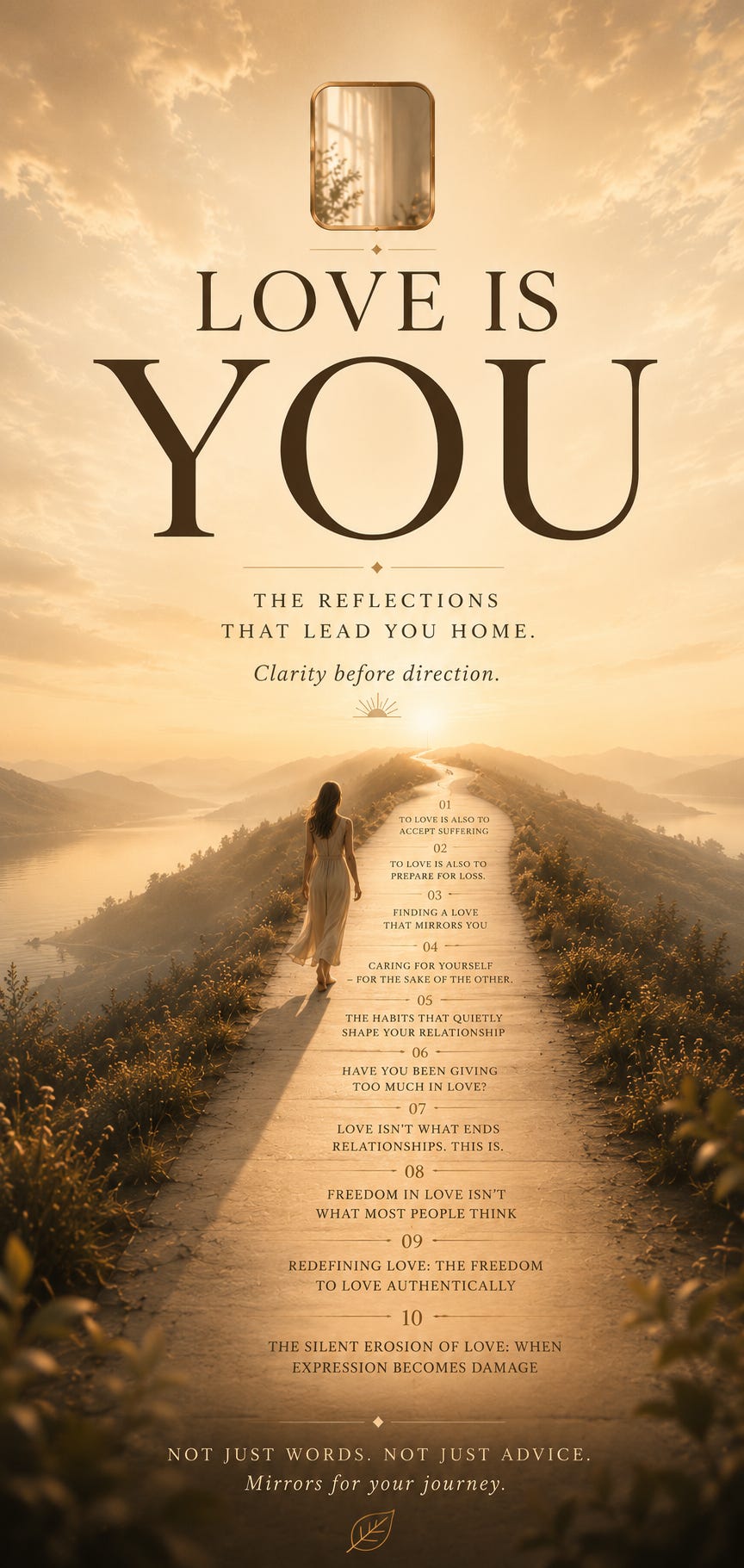
As a small token of gratitude, here is a little wallpaper inspired by these reflections. May it remind you to pause, observe, and see a little more clearly.
The deepest love I have ever witnessed was never loud. It looked like remembering how they take their tea. It looked like patience after misunderstandings. It looked like two people meeting each other again and again through every version of themselves. Love is not a treasure buried in the earth. It is a garden asking, every day, “Will you tend to me too?” 🌿☕️
I have come to believe that the path toward finding and living a fulfilling love begins with knowing yourself.
This was the answer to a quest I had about fulfilling love while writing my post. Thank you Odel for sharing your wisdom on love.
I have shared the link to my post in case you would like to read it.
https://aquietleaf.substack.com/p/still-trying?utm_source=share&utm_medium=android&r=5u2edq