
Disclaimer
These reflections are intended for self-observation and personal exploration. They are not a substitute for professional mental health support. If a reflection brings up overwhelming emotions, consider pausing and seeking support from a qualified professional.
The Mirror
We often think of identity as something we discover. But, it is also something we build. Long before we could describe ourselves, we were already learning how to live in the world around us.
We watched.
We copied.
We adapted.
Some parts of who we became were shaped by love. Some by fear and others by necessity.
I smiled a lot. Long before, too much sometime. And for a long time, I never questioned why I smiled that often.
When someone insulted me, when I felt hurt, I simply smiled. For years, I thought it was just my personality. But lately I started to wonder if it had started much earlier.
I grew up in a home filled with conflict. I hated seeing people that I loved hurt each other with words. As a child, I quietly chose not to act that way.
So I’m hurt, instead of fighting back, I smiled. I walked away. I kept my anger inside.
Today, I no longer need to silence myself the way the child did. I have learned healthier ways to express my limits.
Yet the smile remains.
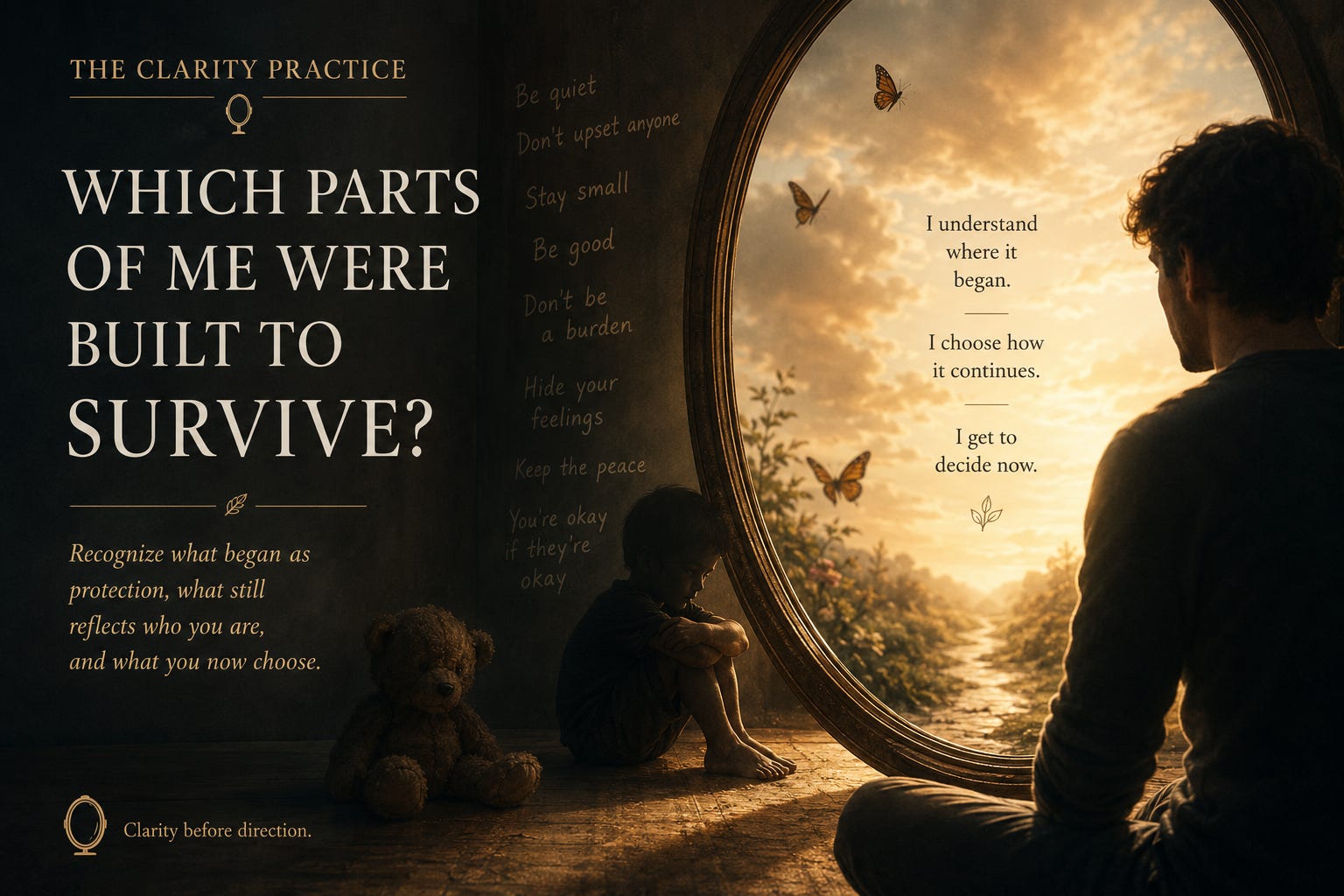
It’s true that some parts of our identity may have begun as protection. some may still reflect who we truly are.
Others may simply be old strategies we never stopped repeating.
This week’s practice is an invitation to ask:
Which parts of my identity still belong to me... and which parts were built to survive?
This Week’s Clarity
This practice will help you:
recognize a part of your identity that may have developed through adaptation;
distinguish between the strategy that shaped it and the person you are becoming;
consider whether this part of yourself still reflects your values today.
You do not need to reject every part of your childhood. You are simply learning to recognize what you inherited... what you built... and what you now choose.
The Structural Lens
Environment → Adaptation → Repeated Identity → Adult Awareness → Conscious Choice
Children do not simply react to events.
They also begin becoming someone.
Over time, repeated adaptations can feel so familiar that they become part of our identity.
Awareness allows us to ask a new question:
Is this still who I want to be?
Before You Look
This practice is not about deciding that your personality is fake. Nor is it about blaming the child for adapting. The child responded to the world they knew. Many of those responses were intelligent. Some may still serve you. Some may not.
The purpose of this practice is not to erase your identity. It is to understand how it was built. Because sometimes what feels like personality began as survival.
Sometimes it became something beautiful.
Sometimes it quietly asks to evolve.
Gladly you do not have to decide today.
Simply observe.