


Welcome back.
In the previous articles, we shared reflections on Understanding Identity as something that grows, shifts, and evolves. This new article marks the beginning of the second chapter in my essay: “The Traps of Identity.”
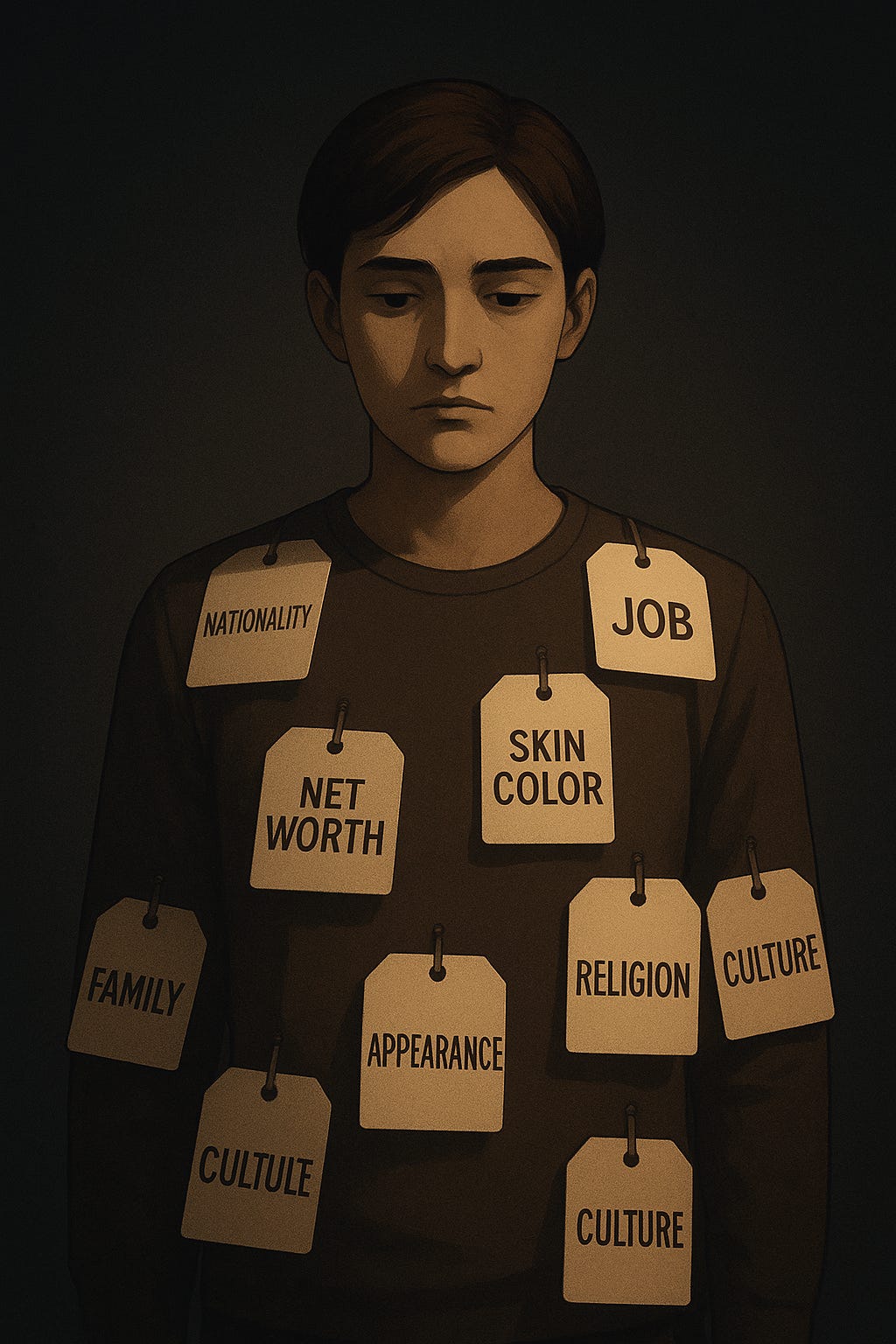
It’s about the ways we’re often seen before we’re truly known—the assumptions, labels, and masks that precede our voice.
I want to say this gently: if some reflections in this chapter feel heavy, I understand. This isn’t about complaining, judging, or condemning. It’s about trying to understand—together.
My hope is that by naming these traps, we can all become a little more aware... and maybe, just maybe, create a world that sees people more clearly.
Thank you for being here.
***
More Than Just a Game
I’m not much of a sports fan—by which I mean I don’t spend my evenings watching games, I don’t know the schedules or the rankings, and I’ve never attended a live sporting event. At least, not yet. Still, I know that in this world—whose rules may seem obscure to the uninitiated—there are individual sports, but also—and it’s the latter that I want to focus on—team sports, where the stakes often go far beyond personal performance.
I said I’m not passionate about it, but that doesn’t stop me from appreciating the joy sports bring to others: that spark in the eyes at the final whistle, that collective thrill that only a hard-fought victory can trigger. And what fascinates me, maybe even more than the game itself, is this almost magical ability a team has to influence a person’s mood—and sometimes even the mood of an entire nation.
For outsiders like me, this fervor might seem exaggerated, almost strange; but when you take a closer look, it becomes hard not to admire the sincerity of these emotions—or, at the very least, not to smile at such a display of shared passion.
There’s nothing wrong, after all, with letting yourself be moved by the passions of others, as long as you know how to savor them without losing yourself in them.
What seems most beautiful to me in all this is perhaps everything that surrounds a team: the community it brings together, the culture it shapes, the colors it flies, the chants it inspires, and even the everyday gestures that, through repetition, become rituals.
A genuine identity emerges—sometimes spontaneously, sometimes deliberately constructed—with its own codes, values, pillars, heroes, and even myths. What’s fascinating is that this identity, although external to the individual, ends up defining them, turning them into a visible fragment of something larger than themselves, inviting them to disappear just enough to exist through it.
In the first part, we explored the idea that identity is a system we build for ourselves—a framework we inhabit and continue to shape as we grow. But isn’t that exactly what happens within a sports team? A structure we commit to, that we feed with our efforts, that we strengthen through loyalty, and that, in return, shapes us.
The individual then becomes recognizable not for who they are, but for what they represent—or rather, for what they belong to. They’re no longer just “themselves,” but “one of them,” and that’s often enough to form, in the eyes of the world, a complete identity.
The Teams We Belong To—And the Ones That Claim Us
As I see it, we are all part of a team—or rather, a category, a group, a collective by which we can be identified, and through which the rest of the world defines us, often without knowing us at all.
What’s striking is that these labels—whether flattering or unfair—are not always assigned based on what we’ve done or who we truly are, but simply because we belong to a particular team, recognized by one or more visible aspects of our identity.
And there are so many of these teams. Groups, classes, overlapping affiliations that shape us—and sometimes confine us. Some we choose, others are imposed. They’re fragments of who we are, layers of identity through which we’re categorized—sometimes fairly, but more often without nuance, without giving us the chance to exist beyond the label.
The hardest part in all of this is that some of these affiliations are not a matter of choice. They were handed to us before we were even aware of our own existence.
We don’t choose the color of our skin, or the place and time of our birth. We don’t choose our natural appearance, our native accent, our first language, our cultural background, or our ethnic identity.
That doesn’t mean everything is fixed—growing up, we may find ways to reshape certain aspects of who we are: our values, beliefs, political stance, lifestyle. And just like some athletes switch teams to align better with their goals, we too can walk away from some affiliations and embrace new ones—sometimes by conviction, sometimes out of necessity.
Yes, we change.
We change religions, ways of thinking, ideals, passions, careers, relationships, and causes. But there is always a part of us—an origin, a core—that cannot be erased.
We can adopt a new nationality, change our accent, immerse ourselves in another culture—but nothing fully wipes away where we come from. That place, like certain invisible marks of our personal history, stays with us—whether we like it or not.
Even when we manage to hide these aspects from the outside world, they remain visible in the gaze of the one watching us silently from the mirror. And that gaze is never fooled.
What They See Before They See Us
Each of us, at some point in our life, has experienced the effects of that part of our identity we didn’t choose. Sometimes it benefits us—it opens doors, shields us, grants us a form of respect or privilege. Sometimes, it holds us back.
And this holds true regardless of our individual situation: whether rich or poor, attractive or not, educated or uneducated, citizen of a powerful country or of a forgotten nation—we all carry the marks of the team we’re associated with, and we all draw from it—consciously or not—certain advantages. But many of us also carry the weight of disadvantages—heavier than we admit, more insidious than we imagine.
What others see first is not always the person we are, but the image of the team we’re presumed to belong to. That image comes before our name, our gestures, our intentions. It acts like a mask—imposed, glued to our face before we’ve even had the chance to speak.
***
Core message:
We are all shaped by the teams we belong to—some chosen, others inherited—and these group identities profoundly influence how we see ourselves and how the world sees us, often before we’ve had a chance to show who we really are.
***
If this reflection stirred something in you, here are a few questions you might want to sit with—not to solve anything, but simply to notice what’s already moving inside:
Which parts of your identity do you feel you chose—and which were chosen for you?
Have you ever been seen or judged through a “team” you didn’t consciously choose? How did that shape your sense of self?
What group or community has helped shape you the most—and do you still feel like you belong there?
If you feel like sharing, leave a comment or send me a DM. I’ll be glad to listen, talk, and answer you.
See you next week, for the next shape of this journey through The Traps of Identity.
Warmly,
Odel Asseille
The Mirror Room – First Edition