


🪞Welcome to the First Edition of The Mirror Room
A Series of Reflections on Identity
Hi again — I’m truly glad you’re here.
This article marks the beginning of the First Edition of The Mirror Room, a collection of reflections centered around one of the most personal and universal questions we face: Who am I?
These writings come from a long-form personal manifesto I wrote — a deep, introspective piece that I’ve decided to share in weekly installments, broken into shorter, digestible reflections.
Instead of presenting it as one single post or publishing it all at once, I’m releasing it piece by piece, so each entry can be read slowly, lived with, and returned to — a space to pause, think, and reflect.
Because platforms like Substack and Medium often separate articles from their larger context, I want to be clear from the beginning:
➡️ What you’re reading here is part of a continuous whole.
Each article in this series is a fragment of a broader journey — a living conversation about identity, self-construction, transformation, and inner truth.
So whether you’re reading this now or stumbling upon it weeks later, I invite you to follow the thread however it comes. You can start here, or jump ahead. Go in order, or go where your curiosity leads.
This is not a story with a fixed beginning, middle, and end.
It’s a mirror you can return to — again and again — as you change, grow, and ask new questions.
Thank you for being here at the start.
Let’s reflect — together.
INTRODUCTION — Why This Manifesto?
Identity: A Universal and Unfinished Question
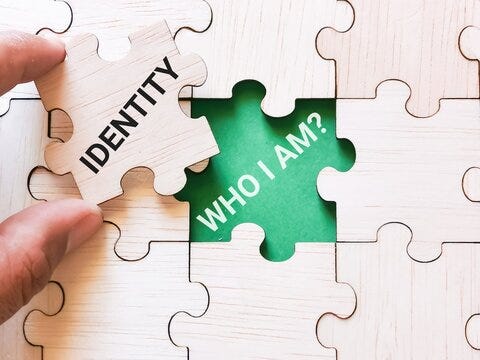
This is a question that each of us will inevitably ask ourselves — sooner or later. It seeps into our thoughts, sometimes in silence, sometimes like a storm:
“Who am I?”
It’s an ancient, intimate, visceral quest.
It begins in childhood, often without us even noticing. It hides behind our games, our dreams, our naïve ambitions. When we say, “I want to be a firefighter, a doctor, an astronaut…”, what we’re really trying to do is give our identity a face.
For some, that image is clear, almost instinctive. For others, it remains blurry, elusive — like a puzzle with no reference image, or a construction site with no end in sight. At times, we think we’ve found it, only to realize it’s slipped away again.
This quest never truly ends. We move forward, then fall back. We get lost, we stagnate. Then we shift, grow, begin again. Sometimes, we even reinvent ourselves completely.
It is this search that drove people to build empires, write masterpieces, change the world — or simply try to transform themselves.
Men and women, like so many others, have embarked on this journey of identity not through books, but through struggle, disorder, and silence.
Nelson Mandela, South African anti-apartheid revolutionary and political leader who became the country’s first Black president, could have been defined by his chains or the walls of his prison cell. But he chose a different path: to redefine himself. In the shadows of apartheid, he shaped an identity grounded in peace and resistance. It wasn’t an identity imposed on him, but one he embraced — one that had the power to restore hope to an entire people.
Frantz Fanon, psychiatrist, philosopher, and revolutionary writer from Martinique known for his works on colonialism and the psychology of oppression, was torn between cultures, languages, and skin colors. He sought meaning in this inner fracture. By analyzing the invisible wounds of colonialism, he gave voice to those who had been dispossessed. Amid the chaos, he unearthed a powerful narrative built on a liberated, reimagined identity.
How many of us carry these silent fractures, trying to piece together the scattered parts of ourselves?
Each name mentioned here is not a myth — but a mirror.
Frida Kahlo, Mexican painter celebrated for her vivid self-portraits and exploration of identity, postcolonialism, and pain, never hid her scars. She painted them. She built her identity from raw emotion, lived pain, and embodied culture. Her journey shows that it’s possible to turn our wounds into language, and our stories into art.
Malcolm X, African-American Muslim minister and human rights activist known for his powerful advocacy for Black empowerment and self-determination, lived several lives in one. He was lost, then found. Angry, then clear-eyed. His search for identity wasn’t linear — it was a process. Each step, each name, each transformation brought him closer to a truth greater than himself.
Robert Kiyosaki, entrepreneur and author of personal finance books such as Rich Dad Poor Dad, experienced that inner tension. Torn between two father figures — one rich, the other poor — he could have remained trapped in that conflict. Instead, he transformed it into a question. By choosing which lessons to follow, he forged his own financial and educational identity. His work continues to inspire those seeking to think differently — beyond traditional models.
Through each of these journeys, one truth becomes clear: identity isn’t a privilege reserved for a select few heroes. It’s a quest that each of us can undertake, in our own way, in our own lives.
And you?
Among all the voices living within you, which ones do you choose to hear?
The voice of the past?
The voice of the world?
Or the quieter one — the one that speaks when everything else falls silent?
Martin Luther King Jr., American civil rights leader and Baptist minister renowned for his role in advancing civil rights through nonviolent activism, drew from his faith, his readings, his wounds, and his dreams to forge a voice, a cause, and a destiny. He didn’t merely exist in a divided America — he rose above it, grounding himself in an identity built on nonviolence, hope, and a broader vision of humanity.
These names aren’t meant to impress. They serve to remind us of something essential: identity doesn’t fall from the sky. It must be sought. It must be challenged. It must be built. And sometimes, it becomes a torch — fragile, yet powerful — that shines far beyond the one who carries it.
A Mirror, Not a Monument
This list could go on. There are so many souls, known and unknown, who have made this quest their battle, their path, their silent work. Builders of the self. Explorers of the inner world. Emblematic figures — and ordinary people with extraordinary journeys.
If we were to name them all, it would take entire lifetimes.
But this manifesto isn’t here to say everything. It exists to open a space. To offer a starting point. To hold up a mirror.
Because the most important thing isn’t found in the names we cite, nor in the stories we tell.
The most important thing lies elsewhere.
This quest is also mine.
And perhaps — it’s yours too.
Where the Real Journey Begins
But beyond the iconic figures and the stories we recount, identity also takes shape in ordinary moments. In silences. In the glance we sometimes avoid in the mirror. In that question that returns, uninvited:
“Am I really myself?”
It’s not always in grand decisions that the change happens, but in the tiniest gestures — moving to a new city, changing jobs, shifting social circles, softening our tone, or even something as small as a haircut. It’s there, in those subtle choices, that we sometimes feel something stirring within us.
Maybe you’ve already felt those tensions — that blurry moment when you’re no longer quite the person you were yesterday, and not yet the one you’re becoming.
It’s to that version of you that this manifesto speaks.
Not to the ideal you’re chasing.
Not to the image you project.
But to you — with your doubts, your intuitions, your fragments of truth.
That’s where the real exploration begins. Not in the noise of the world, but in what stirs within you, when everything quiets down.
This manifesto is not a complaint. I’m not writing to accuse or to judge. I don’t have ready-made answers. And I don’t pretend to have understood what so many are still searching for.
I’m not a philosopher. I’m not a psychologist. I’m an ordinary person. I doubt, I observe, I get lost sometimes — and I search.
Maybe like you.
I write to understand. To clarify what I feel. To put words to this inner journey we share — the search for identity. That complex blend of who we are, who we think we are, and who we hope to become.
And if, through my words, you manage to find your own… if my questions help you uncover some answers — then this manifesto will have fulfilled its purpose.
This is just the introduction in a much larger conversation.
If this spoke to something in you — even quietly — I invite you to follow or subscribe so you don’t miss the next entries. Each one is a step deeper into the journey.
🪞Now I’d love to hear from you:
When did you first start asking yourself: “Who am I?”
Was there a moment — a gesture, a decision, a rupture — when you felt something begin to shift inside you?
If you held up a mirror to who you are today… what would you truly see?
Feel free to share your thoughts in the comments — your voice matters here. It might resonate with someone else too.
I have a question. When you ask yourself, 'Who am I, really?', how do you know which answer is the right one? Do multiple answers come to you at once, or does a single one emerge? Does the question 'What did I want to become?' ever have anything to do with who we actually became—or who we became while we were striving to be that exact thing? I know that’s more than one question, but since we’re on the subject, I’m curious to hear how others’ answers sound to the questions I ask myself. But I mean the answers of ordinary people—not psychologists or psychiatrists, just regular people. Thank you for this text; it leaves so much room for thought.