


🪞 Previous Mirrors in This Series:


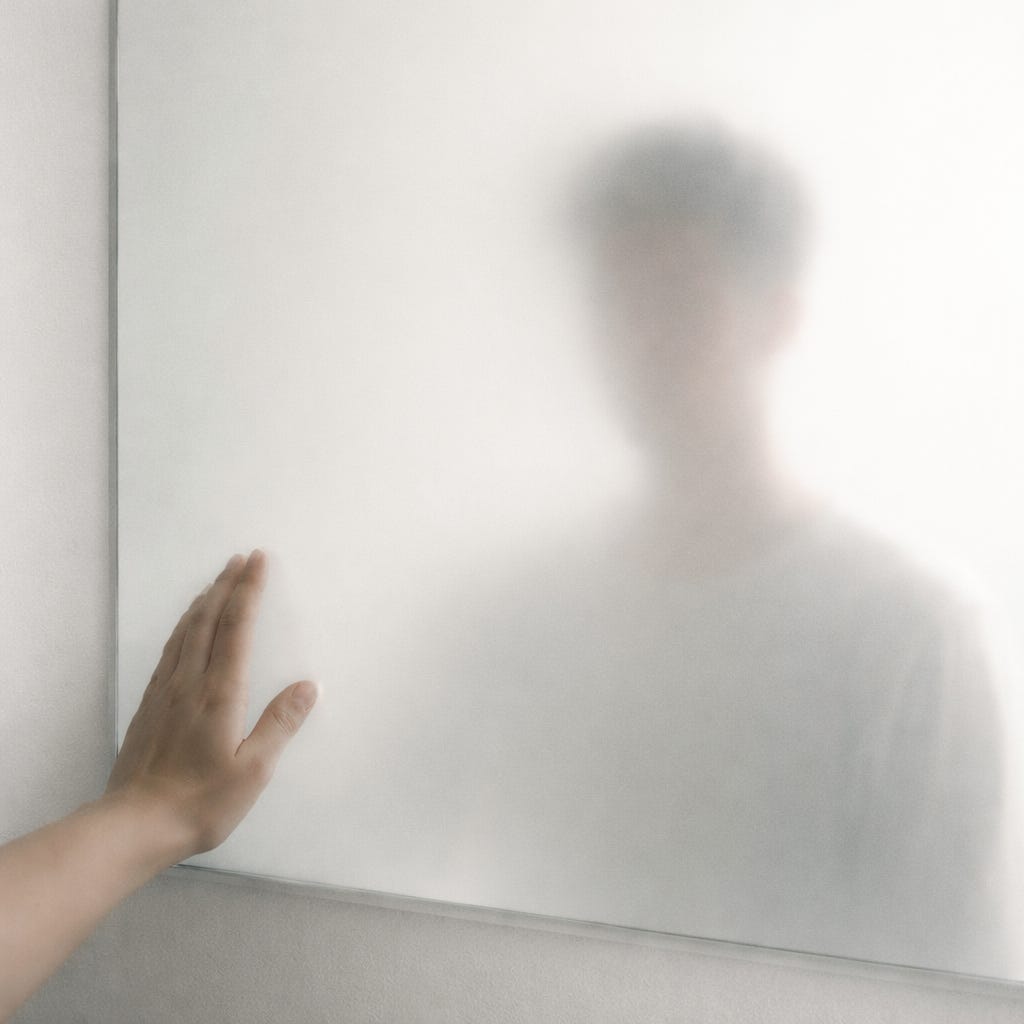
I have seen people give everything in the name of love — their time, their patience, sometimes even their dignity — believing that unconditional devotion was proof of sincerity. What I observed instead was something far more fragile: the more they gave without limits, the less stable the bond became.
And slowly, I came to question the very idea of unconditional love within romantic relationships. As seductive as that ideal may sound, it often feels more like a myth than a lived reality. Love without conditions or reciprocity does not always create depth — sometimes, it quietly creates imbalance.
I know this is a bold statement. It might spark strong reactions or opposing views—and that’s a good thing. The goal here isn’t to establish absolute truths, but to open up a space for reflection. Let’s think through this together; stay with me in the room until the end.
The Different Faces of Love
Take money, for example. When we hear the word, we first think of its value. But depending on where you are in the world, it may take different forms: dollars, euros, pesos, gourdes, yen, crypto... Money is a universal concept with many variations.
Isn’t it the same for love?
There is divine love, parental love, the love between siblings, family, or friends… and then there is romantic love. Some of these forms can, indeed, be unconditional. Sometimes we love without understanding why. We care for certain people without any logical reason. We look for reasons—often superficial ones—but the deeper “why” remains elusive.
“The heart has its reasons of which reason knows nothing.”
I believe every one of us, at some point, has loved unconditionally: a parent, a child, maybe even a partner. So, it seems possible to love without self-interest or expectations. At least, some have experienced it.
But loving someone and building a relationship with them feel like two very different realities to me. One doesn’t necessarily lead to the other.
You can love someone deeply without ever being in a relationship with them—and vice versa.
Perhaps that is one of the great misunderstandings of our time.
When Love Becomes Blind
I’ve often noticed that whenever someone lists the qualities they’re looking for in a partner, there’s always someone else who speaks up to say that none of that matters in the name of “unconditional love.”
Some even point to 1 Corinthians 13 to justify this idealistic vision of love. Yet, that same Bible also speaks of mutual responsibilities: that a man should care for his wife, and a wife should honor her husband. Even from a spiritual perspective, love seems to come with responsibilities.
I say this often to those around me and to anyone willing to listen:
If you love someone so much that you make excuses for them when they hurt you, you need to seriously ask yourself if you should be building a relationship with that person.
Love with your heart, yes—but never set aside your mind or your reason.
Too often, I’ve been a silent witness to men and women—friends and loved ones—who loved blindly, unconditionally… and suffered in silence. When love isn’t reciprocal, it can become a double-edged sword. It makes you vulnerable.
The more you give of yourself without conditions, the more you risk losing value in the other person’s eyes. When you let yourself fade into the background for too long, eventually, you stop being seen altogether.
A Lesson in Boundaries: Love and Friendship
An uncle of mine once introduced me to a man who, according to him, loves his wife unconditionally. I met this man. He knows his wife is cheating on him. His family knows. Her family knows. These aren’t just rumors—he actually caught her in the act once.
Yet, instead of leaving her, he chose to leave the country with her. The result? She’s still cheating. He knows it, and yet… he married her.
Situations like this always make me think. Many believe that by investing more into a broken relationship, the other person will eventually change—or learn to love better. Perhaps that belief is comforting, but it guarantees nothing.
Sometimes, the more you give without conditions, the more you are taken for granted.
Perhaps protecting yourself isn’t a lack of love, but a form of clarity. Setting boundaries isn’t a betrayal of the bond. Sometimes, it’s the only way to avoid losing yourself in it.
When Friendship Becomes a Mirror
I went through something similar myself, though it wasn’t in a romantic relationship. It was a friendship. And friendship, after all, is a form of love too, isn’t it?
I had a friend. There was never anything romantic between us. I was a good listener, always there, especially when she was going through a hard time. I’m naturally sensitive, and I try to make myself useful to others.
But very quickly, I started to feel like she was only around when she needed something.
I don’t like pretending, so I talked to her about it. Of course, she denied it. I didn’t believe her, but I didn’t want to push it. So, I let it go. I kept acting as if everything was fine.
One day, after finishing my novel—a story that ends with the kind of reflections she often shares on social media—I asked her to read it. It wasn’t about ego. I had already hired a professional beta reader on Fiverr.
I just wanted her take on it.
I even offered her half of what I’d paid on Fiverr, plus a little bonus: if she got her friends to read it and gave me their feedback, she’d get 50% of that amount for each person.
She wanted me to give her the money upfront. I refused.
Days passed. Then weeks. I asked if she’d had time to read it. She told me she’d forgotten, that she hadn’t had the time. I simply said: “Thanks, forget about it.”
I was disappointed, but not surprised.
I cut ties with her. A few months later, she sent me a message:
“Hey! How are you?”
“I’m starting a new project, I’d love your help with it.”
I didn’t reply. She insisted, again and again. Then, one morning, she called me.
After the small talk, she got straight to the point. She called me out on my silence and asked for my help. I said no.
Then she snapped at me:
“You’re my friend, you’re supposed to help me.”
At that moment, something inside me snapped too. I took a deep breath. And I told her simply:
“Our friendship died a long time ago.”
Unconditional Love: Myth or Silent Trap?
That experience made me think. And I believe romantic relationships work the same way. In a couple, I feel that both people must be there for one another. Otherwise, you end up with one person giving… and the other getting used to receiving—all under the guise of “selfless love.”
People often tell me:
“True love endures everything and asks for nothing in return.”
So, let me ask this:
Say I love someone and we get together. I give my all, doing everything to make her happy without ever demanding anything, because I believe my love is sincere.
But what if she doesn’t do the same for me?
If unconditional love dictates that I must always take care of her, then who takes care of me?
Who looks out for my happiness?
Too often, we expect reciprocity to be spontaneous. We treat others the way we want to be treated, hoping they’ll do the same. But I’ve learned that hope isn’t always enough. Some things deserve to be said. We should be able to name them, to claim them.
Perhaps we actually have the right to demand reciprocity.
It reminds me of a song by the Belgian singer Jacques Brel, Sans Exigences (Without Demands). He sings:
“She saw me as having no demands; she believed I had no needs.” (“Elle me voyait sans exigence, elle me croyait sans besoin.”)
When you demand nothing, you risk being taken for granted. And with the wrong person, that can quickly become a living hell.
Brel also said that people often mistake patience for weakness. On that point, I think he was right.
What the “oppressor” doesn’t always see is that the victim isn’t weak. To endure so much pain, to forgive over and over again—that takes immense strength. It’s not weakness. It’s patience.
But eventually, patience runs out.
And when it fades, indifference slowly takes its place.
And with indifference… love eventually falls silent.
To me, unconditional love in a relationship seems dangerous.
I do everything in my power to fulfill my partner, but I expect them to do the same. Because if I can’t find my place or my happiness in a relationship, it would be naive to believe that the void will stay silent forever.
How many men and women have loved with all their hearts, without ever receiving anything in return?
And when a glimmer of light appears elsewhere, it’s easier to judge than to try to understand what was already broken.
I’m not justifying cheating. Today, we are free to end a relationship when it no longer works for us. But that freedom shouldn’t stop us from looking at the reality—the sometimes painful reality—that some people live through in their relationships.
Perhaps the danger doesn’t lie in love itself, but in the lack of boundaries around it. By loving without conditions, you can end up accepting everything. And by accepting everything, you can slowly lose yourself.
Loving shouldn’t mean fading away. Giving shouldn’t mean disappearing. Love is powerful, but left to its own devices, it can become blind.
So, the real question might not be:
“Does unconditional love exist?”
But rather:
Can we build something solid without ever defining what is acceptable—and what is not?
🪞 Mirror for Reflection
Sit with this quietly:
When I say I love unconditionally…
am I loving freely —
or am I allowing everything?
—
If this reflection resonated, take your place in the Room.
Enter as an Observer.
Remain as a Mirror Keeper — sustaining the space and stepping deeper into the work.
🕯️ Tomorrow — Inside the Evening Mirror
On Sundays, we open the reflection.
On Mondays at 7:30 PM, we step inside it.
Where the Sunday post invites you to feel and question,
the Evening Mirror examines what lies beneath:
• the hidden patterns
• the structural imbalances
• the mechanisms shaping the bond
• the questions that test sustainability
Some reflections are meant to be felt.
Others are meant to be understood.
If you’d like to sense the rhythm of this second layer, you can read two open examples here:
– 🪞 The Evening Mirror: The Loss-Anticipation Paradox
– 🪞 The Evening Mirror : The Identity-Congruence Principle
The mirror slows down tomorrow.
Next in the series:
7th Reflection on Love: What Keeps Love From Falling Apart
With clarity,
The Mirror Room
Odel Asseille
Genuinely thought-provoking.
The distinction between loving someone and building a relationship with them is one most people collapse into the same thing and you're right that they're very different realities.
Do you think it's possible to communicate reciprocity needs early enough that they don't become ultimatums?
okay i'm def guilty of this, feeling taken for granted really hurts. now taking a step back and rethinking my life decisions