


I have always held my father in high regard. He is someone I love deeply. Despite the fear I sometimes felt toward him, I always felt close to him and safe with him.
Before I began reflecting and trying to understand my childhood, I had never considered my father responsible for any of it. Unconsciously, I blamed my mother far more than him. In the story my mind had constructed, he was the hero.
Perhaps because I learned very early that when my mother wanted to abort me, he did everything he could to stop her. He replaced the medication. Those two stories always came together: my mother wanted the abortion, and my father prevented it.
I think that, unconsciously, I saw him as my savior. And like every story, there was an antagonist. That role naturally fell to my mother.
Today, after revisiting that period of my life and reflecting on what I inherited from both of them, I admitted for the first time that my father was just as responsible as my mother. Like her, he continued telling that story, and it also created an emotional distance between me and both of them—a kind of imbalance.
I believe that seeing him as my savior, as someone I could always feel safe with, brought me many good things, but it also created many difficulties.
I am deeply grateful to him. He is a wonderful father. Nevertheless, whenever I try to understand the roots of my fears, many of them lead me back to him and to moments from my childhood.
Of course, this is not about blaming him. Rather, it helped me understand something important: our blind affection for a parent can hide many of the childhood wounds we still carry. Their influence can be much deeper than we realize.
Trauma does not come only from physical or psychological abuse. A lack of trust from our parents, for example, can have far deeper consequences than we might imagine. Unfortunately, that too becomes part of what we inherit from them—or more precisely, behaviors we develop because of them.
Not long ago, I realized that I have a tendency to over-explain myself. Even when I feel I have expressed myself clearly and already given enough information to convince the other person, I often feel the need to keep adding more. I always have this urge to continue persuading them. Naturally, it was something I deeply disliked about myself.
The sad reality is that the more we explain ourselves, the less effective our words become. Even when we are telling the truth, too many explanations often create more doubt than trust.
Many times I told myself I was going to stop overexplaining. The decision was clear. I wanted to be direct and concise. Yet every time, I found myself explaining too much before I even realized I was doing it. It even affected my writing.
I could not understand why it kept happening when I genuinely wanted to stop. So I began observing myself. Only recently did I begin to understand.
How can we solve a problem if we do not even know where it comes from?
In Haiti, there is a common belief that children are always wrong when they are in conflict with an adult. When there is a disagreement between a child and an adult, the question is never even asked. The child is automatically considered guilty and punished, even when they are right.
In Haitian culture, parents often sided with the adult even when they knew the child was right, believing they were protecting the child from the cruelty of adults.
I believe this practice is no longer as common today.
As a child, I was respectful, and I hated losing. Whenever someone reported bad behavior about me to my parents, I always tried to defend myself, but it was useless.
My father would clearly explain why he had to side with the adult even when he knew I was right. Intellectually, I understood his reasoning. But a part of me refused to accept it. So I kept trying to defend myself.
As I grew older, these situations became less frequent. But that tendency had not disappeared in my father. It had simply found another foundation.
No matter what people told my father about me, if the person was older than I was, he seemed to believe them automatically. Even when I defended myself, he sometimes acted as though he understood and believed me, only to later insist that I apologize to the other person or adapt to the situation.
For example, while I was living in Colombia, I often tried to contact one of my uncles. Almost every time I called, I don’t know whether he thought I was going to ask him for help, but he almost never answered. Eventually, it was always one of his children who answered the phone, telling me he was not there. Somehow, he was never available whenever I reached out after asking him for a little help.
After several attempts, I stopped contacting him completely.
Years later, when I was preparing to leave Colombia, my mother contacted him so he could put me in touch with some members of the family. He told them that I had stopped talking to him, that I never answered his calls or messages anymore.
When my father called to scold me, I told him the whole story.
He acted as though he believed me, but in the end, he still insisted that I should not behave that way. He told me I should not disrespect a member of the family.
He called me several more times about the same situation.
And every single time, I had to explain myself all over again.
This pattern had started when I was very young and continued until I was twenty-seven years old.
Over-explaining had become part of my personality.
It was a trait I had developed because of the way my father related to me.
I think part of the reason was that my father still saw me as a child, despite the fact that I was already an adult. Very often, parents feel that time has passed so quickly that they never fully realize their children have grown up.
Eventually, I had to help my father see that reality.
Growing up, I had been taught that talking back to your parents was a sign of disrespect. And I truly respect my parents deeply. That is why I accepted my father’s attitude for so many years without ever rebelling.
But eventually, it became too much. And I could no longer stay silent.
On my journey to the United States, I had to cross Mexico. Things did not go as planned.
We had a plan, but the impatience of the people traveling with me led us into several mistakes. I had run out of money, and even though I disagreed with their decisions, I had no choice but to continue with them.
After spending almost all of our savings on bus tickets to Mexico City, we were unfortunately detained by immigration authorities. We spent two days in a detention center.
The treatment was not bad. Paradoxically, I actually felt relieved when it happened. (That is a story for another time.)
Before we were detained, my father had put me in contact with one of his friends who had promised to send me some money during the journey. I had already given him all the information he needed.
Two days later, after being released from detention, I realized that the man had never sent the money.
I contacted my father.
He told me that the man had said it was my fault because I had never sent him a picture of my ID.
I explained to my father that the man was lying. He did not need my ID to send the money. He already had all the necessary information.
But once again, my father did not believe me. The more I tried to explain, the angrier he became. Eventually, he began insulting me.
I was so angry that, had he been anyone other than my father, God alone knows what I would have said that day. We probably would never have spoken again.
At that point in my life, I did not yet have the self-control I have today.
I remember recording a first voice message filled with all that anger. Then I deleted it. After calming down, I recorded another one, this time trying to reason with him.
I asked him questions like:
“Do you really think I want to be sitting in a bus station with no money to buy a ticket while everyone else is ready to leave? Do you think I want to spend the entire day without being able to buy anything to eat? Can you imagine the frustration and humiliation I feel right now, having to depend on people who are not even truly my friends? Do you think I chose to suffer just because I am being sturborn?”
There was something else I wanted him to understand. I told him that I had not contacted him because I wanted to. I had contacted him because I had no other choice.
That message must have reached him. Because from that day on, he began treating me like an adult. He supported me in his own way for the rest of the journey. And whenever I shared something with him, his reactions were different.
That experience taught me something important:
Talking back to your parents is not, in itself, disrespectful. The disrespect lies in the way we speak to them.
I believe it is important to earn the respect of our parents as well, within healthy boundaries and in healthy ways.
Even today, my father remains my best friend. He is still one of my greatest role models, and I have inherited so much from him.
I am deeply grateful for everything he has taught me. I began my own journey inspired by his story of resilience, courage, and generosity.
I hope his work will live on. I hope his legacy will outlive both him and me.
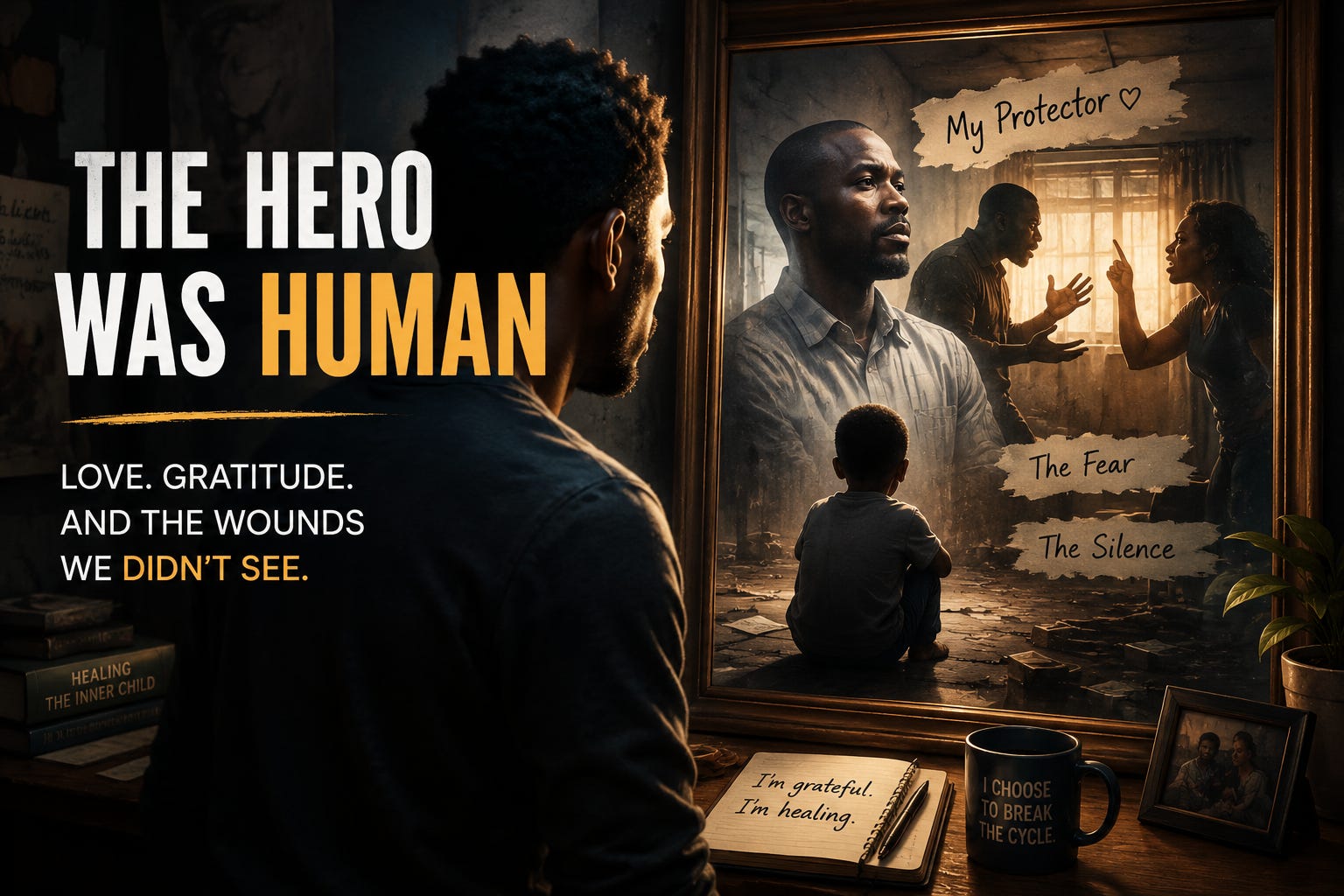
🪞 Mirror Question:
When you look at your parents through adult eyes, what part of your identity suddenly begins to make sense?
This Week’s Poem

CTA
“The greatest discovery in life is self-discovery. Until you find yourself, you will always be someone else. Become yourself.”
— Myles Munroe
If this reflection resonated with you, take the next step.
The Clarity Practice is where reflection becomes action. It helps you uncover the childhood conclusions still shaping your relationships, decisions, and identity—so you can begin making conscious choices instead of repeating unconscious patterns.
The longer a pattern remains unseen, the more opportunities it has to shape your life.
Unlock this week’s Clarity Practice by becoming a paid subscriber.
If you can’t subscribe today, you can still support this work with a tip. Your support helps me continuing this work with more freedom and peace in mind.
Thank you for being part of The Mirror Room.
With clarity,
The Mirror Room
Odel A.
I’m glad you finally said it, Odel-chan~ Loving your dad didn’t mean you had to keep proving yourself every time he believed someone else first. You were allowed to be his adult son too.
Odel, this is an incredibly profound and courageous piece of self-reflection. The realization that over-explaining isn’t just a random habit but a survival mechanism meant to convince a parent who refused to hear you is a major breakthrough. It’s common to unconsciously split our parents into a 'hero' and a 'villain' to make sense of childhood pain, but true healing begins when we see them both as flawed, human actors. Your journey to setting that healthy boundary at 27 is a beautiful blueprint for reclaiming your adult voice. Thank you for sharing this.